Section 4.1 · Further exercises · 6 of 20
Exercise 4.1.6: Two parallel wires with opposite currents
About the further exercises of Section 4.1
Twenty further exercises in the spirit of the problems, the worked examples and the home exercises, graded from easy to harder within each group. Exercises 4.1.1–4.1.10 belong to the theory of Lecture 8 (the Lorentz force, Biot–Savart's law, flux, force and the vector potential) and Exercises 4.1.11–4.1.20 to the exercise session of Lecture 9 (Ampère's law, coils and rotating charges, measuring and shaping fields). They use only
the two results of the section, for a long straight wire and on the axis of a loop, and superposition.
Two parallel wires with opposite currents
#cf. Worked example 4.1.1
Two long parallel wires at , carry A in opposite directions ( at , at ), with cm. Find (a) at the midpoint O, (b) at the point on the perpendicular bisector, cm, (c) at a point on the -axis outside the pair, , to leading order.
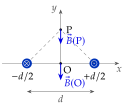
Superposition of two long-wire fields, Eq. (4.1.21), each circling its own wire by the right-hand rule. Between antiparallel wires the two circulations run the same way and add. Far away the terms cancel and only a remainder survives.
Each wire gives along about its own axis (Problem 4.1.1), and the fields add vectorially (Figure 4.1.31).
At O both wires are at . For the wire at , the point O lies in the direction, and . For the wire at , O lies in the direction and reversed by the current sign is again. The two fields are parallel:
Both wires are at cm from P, each giving mT. The field of the right wire at P is perpendicular to the line from to P. By symmetry the -components of the two fields cancel and the -components add, each being with :
(Check: gives , the result of (a). The perpendicular bisector is itself a field line, so the field points along it, in the direction, at every height.)
On the -axis at the two fields are antiparallel ( from the near wire, from the far one):
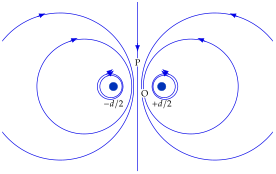
Units: is T. A go-and-return pair is the magnetic analogue of a dipole line: the terms cancel and only the term, proportional to the spacing , survives. This is the reason twisted or closely spaced supply leads radiate little field, and why the three-phase line of Worked example 4.1.3 gives much less than the single-conductor estimate.