Section 4.1 · Further exercises · 14 of 20
Exercise 4.1.14: Current density that vanishes at the surface
About the further exercises of Section 4.1
Twenty further exercises in the spirit of the problems, the worked examples and the home exercises, graded from easy to harder within each group. Exercises 4.1.1–4.1.10 belong to the theory of Lecture 8 (the Lorentz force, Biot–Savart's law, flux, force and the vector potential) and Exercises 4.1.11–4.1.20 to the exercise session of Lecture 9 (Ampère's law, coils and rotating charges, measuring and shaping fields). They use only
the two results of the section, for a long straight wire and on the axis of a loop, and superposition.
Current density that vanishes at the surface
#cf. Home exercise 4.1.5
A long wire of radius carries . Find (a) the total current , (b) inside and outside, (c) the radius at which is largest, and show that the maximum lies inside the wire. Numbers: A/m, mm.

Home exercise 4.1.5 with a density that decreases towards the surface. The enclosed current is again an integral, and can have a maximum inside, where the enclosed current grows more slowly than .
Cylindrical symmetry: . Inside, , so
Both give at .
Inside, at , where
Numbers: A, kA/m, kA/m at mm.
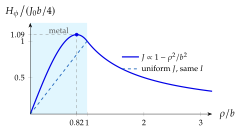
Both branches agree at : continuous, no surface current. Between and the enclosed current grows more slowly than (there is little current near the surface), so falls (Figure 4.1.32). In Problem 4.1.5 ( uniform) and Home exercise 4.1.5 () the maximum sits exactly at the surface. It moves inside whenever the current density decreases towards the surface.