Section 4.1 · Further exercises · 5 of 20
Exercise 4.1.5: Circular arc and a hairpin
About the further exercises of Section 4.1
Twenty further exercises in the spirit of the problems, the worked examples and the home exercises, graded from easy to harder within each group. Exercises 4.1.1–4.1.10 belong to the theory of Lecture 8 (the Lorentz force, Biot–Savart's law, flux, force and the vector potential) and Exercises 4.1.11–4.1.20 to the exercise session of Lecture 9 (Ampère's law, coils and rotating charges, measuring and shaping fields). They use only
the two results of the section, for a long straight wire and on the axis of a loop, and superposition.
Circular arc and a hairpin
#cf. Problem 4.1.2
(a) A thin wire bent into a circular arc of radius and angle carries . Find at the centre of curvature O. (b) A long wire is bent into a "hairpin": two parallel half-lines joined by a semicircle of radius cm, A. Find at the centre O of the semicircle.
Adapted from: D. K. Cheng, Field and Wave Electromagnetics, 2nd ed., Problem P.6-11.
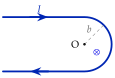
On an arc every element is at the same distance from the centre and perpendicular to , so Biot–Savart's law reduces to the length of the arc. The straight legs of the hairpin are half-infinite segments, Exercise 4.1.4 with .
For every element of the arc and , so , all contributions pointing the same way (along the axis of the arc):
The semicircle () gives . Each straight half-line starts at a point directly "above" O at the distance and extends to infinity: Exercise 4.1.4 with , gives for each, and both circulate the same way round O as the arc, so they add:
gives back the centre field of the full loop, of Problem 4.1.2. A radial straight lead pointing at O contributes nothing (), so the field at the centre of a circuit made of arcs and radial legs is simply summed over the arcs with their signs. The hairpin is the elementary "go-and-return" loop: its field is concentrated between the legs and falls off fast outside (Exercise 4.1.6).