Section 4.1 · Home exercises · 5 of 7
Home exercise 4.1.5: Non-uniform current in a wire
Non-uniform current in a wire
#A long straight wire of radius carries a current whose density grows linearly with the distance from the axis, , where is a constant. Find the total current in the wire, and use Ampère's formula to find inside () and outside () the wire.
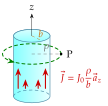
Same symmetry and same circle as Problems 4.1.4–4.1.6, but the enclosed current must now be found by integrating over the disk of radius , with the Jacobian of the polar area element, because the density varies with .
With ,
As in Problems 4.1.4–4.1.6, and on the circle of radius .
The enclosed current is the integral up to (primed variable for the integration):
, so .
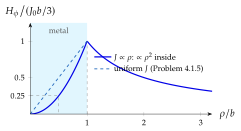
Compare with : a quarter, not a half, because the current sits near the surface.
Both branches give at : continuous, no surface current. Inside, now grows as instead of (Problem 4.1.5), because the current is concentrated towards the surface (Figure 4.1.29). Units: is (A/m)(m) A/m. Numbers: mm and A/m give A and kA/m ( mT) at the surface, and at , kA/m, a quarter of the maximum. A current density that increases towards the surface is a crude model of the skin effect, and the limiting case of a surface current gives inside and outside (Problem 4.1.6 with ).