Section 4.1 · Home exercises · 4 of 7
Home exercise 4.1.4: Charge in crossed fields
Charge in crossed fields
#A particle of charge and mass enters with velocity a region where a uniform electric field and a uniform magnetic field (into the page) are maintained. (a) Write the Lorentz force on the particle at the entrance and find the speed for which it moves on undeflected (velocity selector). (b) Now let . Show that the motion is a circle, find its radius and the period of one revolution. (c) For a proton with m/s and T, evaluate and .
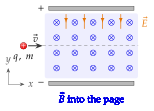
The Lorentz force with both fields present, evaluated at the entrance. For the circle, use the fact that a magnetic force is always perpendicular to , so it only turns the velocity, and Newton's law with the centripetal acceleration.
At the entrance and , so , and
The electric force pushes the particle down, the magnetic force up (for , and both reverse together for ). The particle is undeflected when they balance:
Faster particles are bent up, slower ones down: a velocity selector, which also provides ions of one speed to a mass spectrometer.
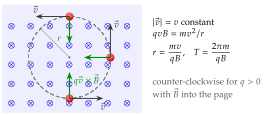
With the force is always perpendicular to : it does no work, stays constant, and a force of constant magnitude normal to the velocity produces uniform circular motion in the plane perpendicular to (Figure 4.1.28). Newton's law with the centripetal acceleration :
i.e. MHz per T ( MHz per tesla).
At the proton passes undeflected. Try 'From rest' for the cycloid, or switch to Cyclotron to read and .
Units: is (kg m/s)/(C T) (kg m/s)/(C N s/(C m)) m. The independence of from the speed is what the cyclotron lives on: an alternating voltage of fixed frequency keeps kicking the ion as it spirals outward. At m/s ( of ) the classical formulae are excellent. For electrons, or for protons above a few tens of MeV, must be replaced by . Note the direction: a positive charge in turns counter-clockwise seen from , since the force at the entrance is along (Figure 4.1.28).