Section 4.1 · Home exercises · 6 of 7
Home exercise 4.1.6: Coaxial cable
Coaxial cable
#A coaxial cable consists of an inner conductor of radius carrying a current along , and an outer conducting shell between the radii and carrying the return current . Both currents are uniformly distributed over their cross-sections. Using Ampère's formula, find in the four regions
and sketch as a function of .
Source: D. K. Cheng, Field and Wave Electromagnetics, 2nd ed., Problem P.6-3.
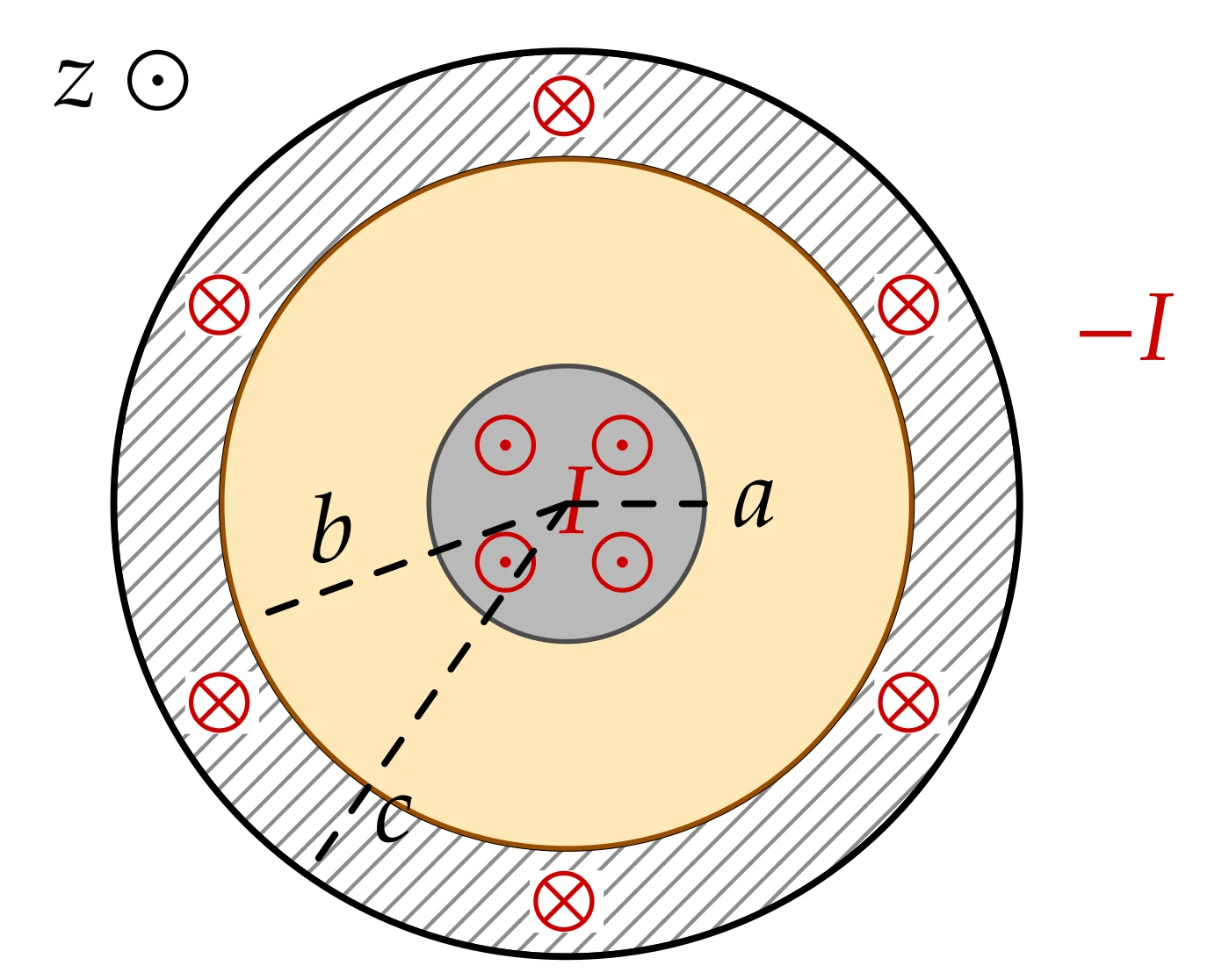
Cylindrical symmetry, one coaxial circle, four regions. The inner conductor is Problem 4.1.5, the shell is a hollow conductor carrying (Problem 4.1.6), and the enclosed current is the algebraic sum of what the circle threads.
for and for , zero elsewhere. The geometry is cylindrically symmetric, so and on every coaxial circle.
(Problem 4.1.5): .
: .
The circle encloses and the part of the return current between and :
: .
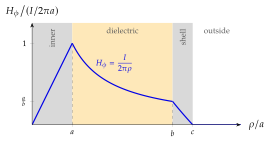
Check 796 A/m at 0.5 and 2 mm, 219 A/m at 3.75 mm, and zero outside the shell.
Continuity at ( from both sides), at ( from both sides) and at ( from both sides): no surface currents (Figure 4.1.30). Numbers for mm, mm, mm, A: A/m at mm and again at mm, A/m at mm, zero outside. Beyond the shell : the whole field is trapped in the dielectric between and (plus the thin shell). This is why a coaxial cable neither radiates its field nor picks up external ones, the magnetic counterpart of the electrostatic shielding of Application 3.2.2.