Section 4.1 · Further exercises · 8 of 20
Exercise 4.1.8: Force on a rectangular loop near a long wire
About the further exercises of Section 4.1
Twenty further exercises in the spirit of the problems, the worked examples and the home exercises, graded from easy to harder within each group. Exercises 4.1.1–4.1.10 belong to the theory of Lecture 8 (the Lorentz force, Biot–Savart's law, flux, force and the vector potential) and Exercises 4.1.11–4.1.20 to the exercise session of Lecture 9 (Ampère's law, coils and rotating charges, measuring and shaping fields). They use only
the two results of the section, for a long straight wire and on the axis of a loop, and superposition.
Force on a rectangular loop near a long wire
#cf. Home exercise 4.1.3
The loop of Exercise 4.1.7 now carries A clockwise in the figure (its near side carries the current parallel to the wire's A). Find (a) the force on each of the four sides, (b) the net force on the loop, magnitude and direction, (c) the net force if is reversed.
Adapted from: B. M. Notaroš, Electromagnetics, Example 4.20.
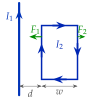
Home exercise 4.1.3 applied to each side. The two long sides sit in different fields, so their forces do not cancel. On the short sides the force is along the wire and cancels between the two.
The near side, at , carries parallel to : it is attracted (Home exercise 4.1.3),
The far side, at , carries antiparallel to : it is repelled,
On the two short sides and , so : the forces are along the wire, equal and opposite on the two sides (the same along each, opposite currents), and cancel. Their magnitude is mN each.
Net force: towards the wire,
Reversing reverses every force: the loop is repelled with mN. The loop is attracted when its near side runs with , repelled otherwise, the rule "parallel currents attract" applied to the side that sits in the stronger field.
A loop in a uniform field feels no net force (the two long sides cancel exactly, as in the DC motor of Worked example 4.1.4). The net force here exists only because falls off as . Written as (the pull towards the wire, ) with the flux of Exercise 4.1.7, , the same value: the loop moves so as to increase the flux linking it when the currents are parallel.