Section 4.1 · Further exercises · 2 of 20
Exercise 4.1.2: Electron in a uniform field
About the further exercises of Section 4.1
Twenty further exercises in the spirit of the problems, the worked examples and the home exercises, graded from easy to harder within each group. Exercises 4.1.1–4.1.10 belong to the theory of Lecture 8 (the Lorentz force, Biot–Savart's law, flux, force and the vector potential) and Exercises 4.1.11–4.1.20 to the exercise session of Lecture 9 (Ampère's law, coils and rotating charges, measuring and shaping fields). They use only
the two results of the section, for a long straight wire and on the axis of a loop, and superposition.
Electron in a uniform field
#cf. Home exercise 4.1.4
An electron is accelerated from rest through V and enters a region of uniform mT perpendicular to its velocity. Find (a) its speed, (b) the radius of its path and the period, (c) the cyclotron frequency and how it changes if is doubled, (d) whether a relativistic correction is needed.
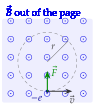
Energy conservation gives the speed, Home exercise 4.1.4 gives the circle. The period depends on and only.
Energy conservation, :
gives
MHz. Doubling multiplies and by but leaves unchanged: the cyclotron frequency depends on and on only ( GHz per tesla).
and : the classical result is low. Fine for V, but at kV () it would not be.
Check cm, ns and MHz, then double : grows by and stays put.
Because , measuring for a known and gives , which is J. J. Thomson's experiment of 1897 in essence. Note the sense of rotation: for out of the page a negative charge turns counter-clockwise, while a positive one would turn clockwise (). The proton of Home exercise 4.1.4 also turns counter-clockwise, because there points into the page.