Section 4.1 · Further exercises · 4 of 20
Exercise 4.1.4: A straight segment of finite length
About the further exercises of Section 4.1
Twenty further exercises in the spirit of the problems, the worked examples and the home exercises, graded from easy to harder within each group. Exercises 4.1.1–4.1.10 belong to the theory of Lecture 8 (the Lorentz force, Biot–Savart's law, flux, force and the vector potential) and Exercises 4.1.11–4.1.20 to the exercise session of Lecture 9 (Ampère's law, coils and rotating charges, measuring and shaping fields). They use only
the two results of the section, for a long straight wire and on the axis of a loop, and superposition.
A straight segment of finite length
#cf. Problem 4.1.1
A straight wire segment of length cm lies on the -axis from to and carries A. (a) Find at a point P at the distance from the segment in its mid-plane , in terms of the angles , shown. (b) Evaluate it at cm and compare with the infinite wire. (c) Find the field at the distance cm from one end, in the plane .
Adapted from: D. K. Cheng, Field and Wave Electromagnetics, 2nd ed., Example 6-4.
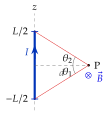
Problem 4.1.1 with finite limits. Every element contributes along with the same geometry, so only the limits of the integral change, and the result is best written with the angles under which the ends are seen.
As in Problem 4.1.1, every element gives a contribution along with and . Only the limits change:
With for the upper end and for the lower one (angles measured from the perpendicular, positive upwards),
This is the general segment formula: , gives back .
,
against μT for the infinite wire: at the segment is already "infinite".
In the plane through one end, and :
half the mid-plane value: only one half of the wire is "seen".
Home exercise 4.1.1 (square loop) is this formula with , , applied four times. The angles version is the one to remember: , or with the angles measured from the wire. Note that no Amperian circle could have given this result: is not constant on a circle round a finite segment.