Section 4.1 · Problems · 6 of 8
Problem 4.1.6: Hollow wire
Hollow wire
#An infinitely long conducting cylindrical wire of radius involves an inner cylindrical hole of radius as shown in the figure and carries a uniformly distributed constant current of flowing in the direction. What is the current density ? By using Ampère's formula, find the explicit expression of the magnetic field in the regions , and .
Source: B. M. Notaroš, Electromagnetics, Problem 4.10.
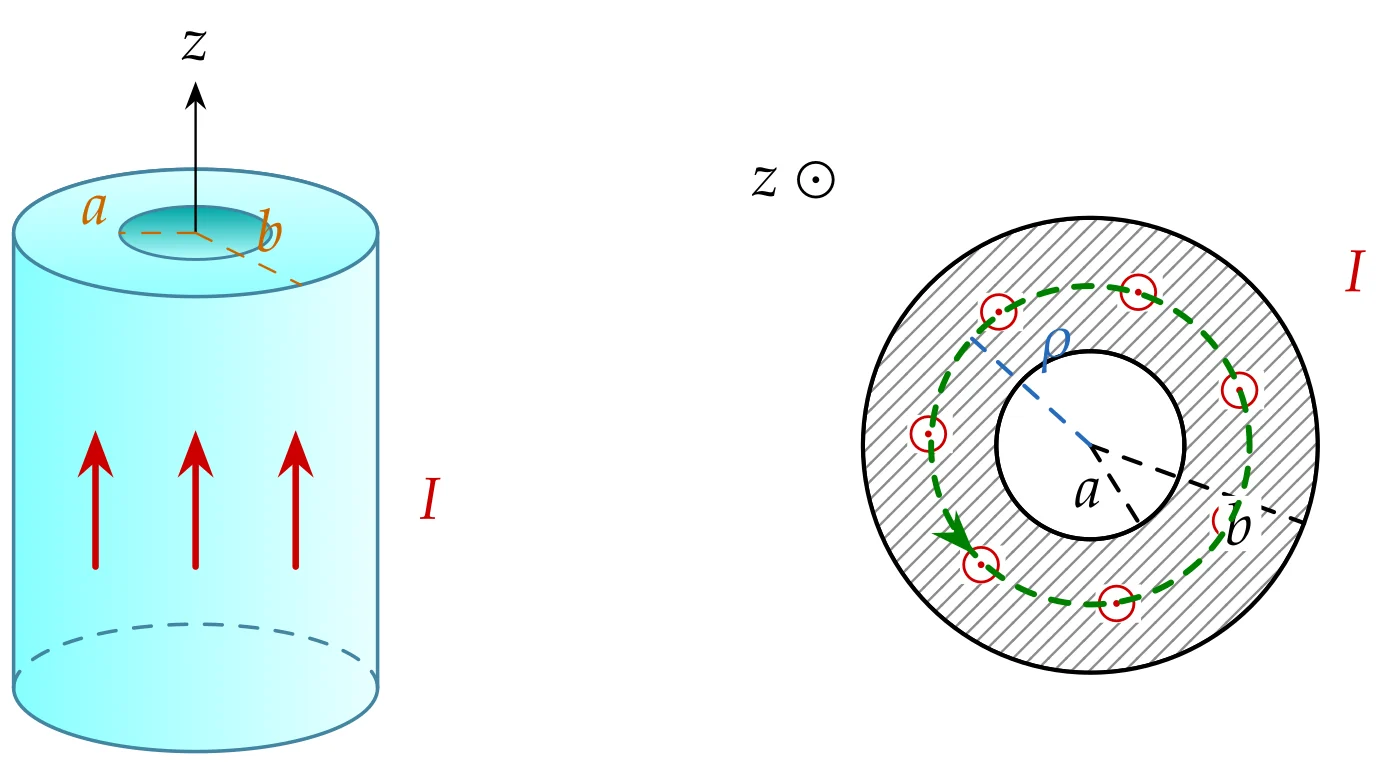
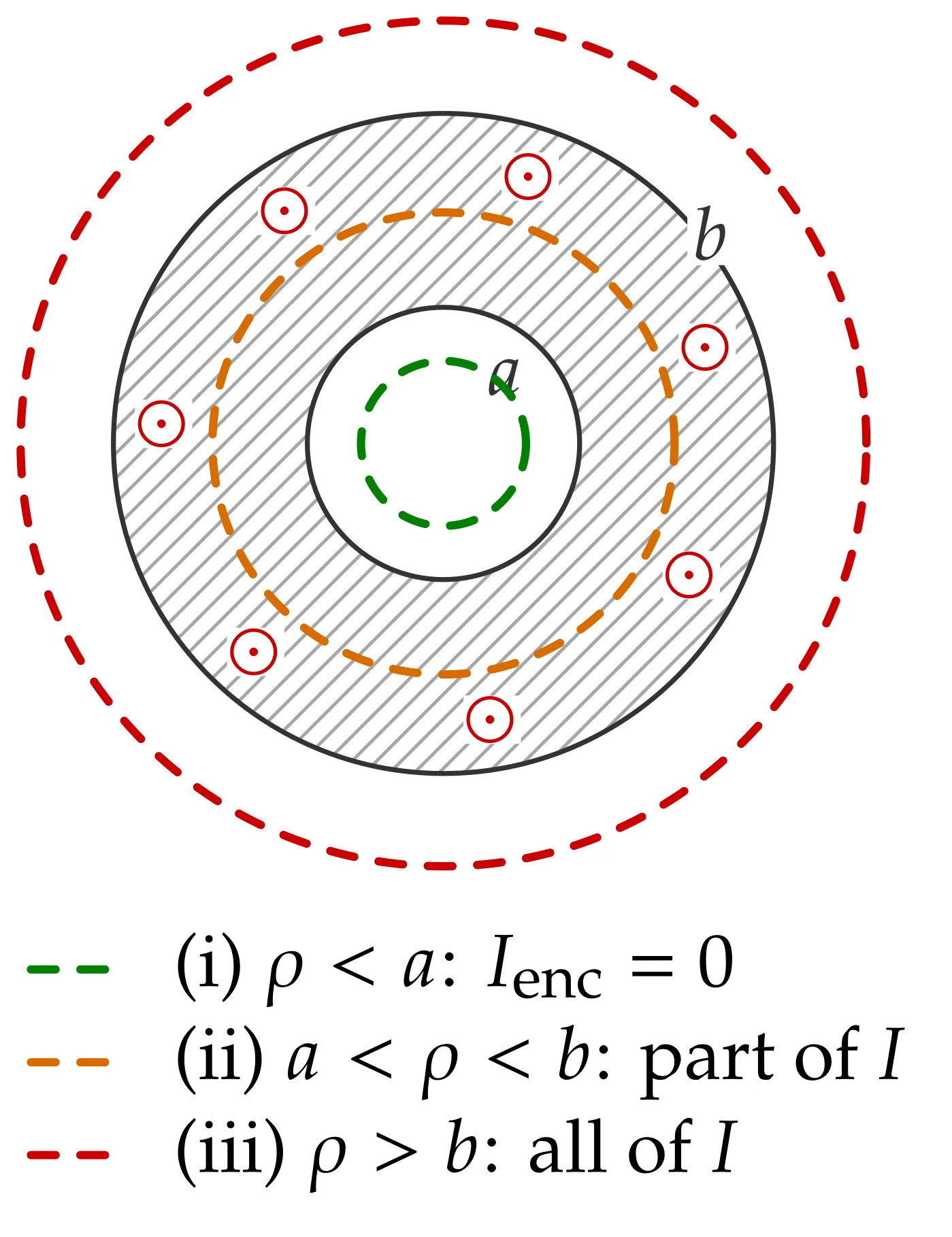
Same symmetry, same circle, three regions: the hole, the metal and the outside. Only the enclosed current changes from region to region, and in the metal it is the current through the annulus between and .
The current is spread uniformly over the annular cross-section, whose area is :
Nothing depends on or , so again and on the circle of radius (Figure 4.1.23a).
For no current is enclosed:
For the circle encloses the annulus between and :
For the circle encloses everything: . Dividing each by :
(in A/m)
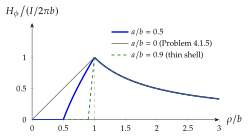
Shrink to zero to recover Problem 4.1.5, and push towards to see a thin shell.
Four checks. Continuity: the middle line gives at and at , no jump, as it must be with no surface current. : it becomes , Problem 4.1.5. : the thin shell, with the whole rise squeezed into the shell. Outside: , from outside and are invisible (Figure 4.1.23b). The hole is field-free not because "the metal shields it": Ampère's law gives on every circle in the hole, and symmetry already forbade and . The peak at the surface depends only on and the outer radius, whatever the hole: the middle of a conductor carries field-free dead metal, which is one reason why busbars are often tubes.