Section 4.1 · Further exercises · 20 of 20
Exercise 4.1.20: Flat spiral (pancake) coil
About the further exercises of Section 4.1
Twenty further exercises in the spirit of the problems, the worked examples and the home exercises, graded from easy to harder within each group. Exercises 4.1.1–4.1.10 belong to the theory of Lecture 8 (the Lorentz force, Biot–Savart's law, flux, force and the vector potential) and Exercises 4.1.11–4.1.20 to the exercise session of Lecture 9 (Ampère's law, coils and rotating charges, measuring and shaping fields). They use only
the two results of the section, for a long straight wire and on the axis of a loop, and superposition.
Flat spiral (pancake) coil
#cf. Problem 4.1.8, Application 4.1.4
A flat coil of turns is wound uniformly from cm to cm and carries A. Model it as an annular sheet with the surface current density in the direction. Find (a) at the centre, (b) on the axis at height , and its values at and , (c) compare the centre field with that of the same turns all placed at .

Problem 4.1.8 with a uniform sheet: cut the annulus into rings, each a loop of Problem 4.1.2, and integrate the on-axis loop field from to .
The ring between and carries and gives at its centre:
With the on-axis loop formula,
which reduces to for . The bracket equals at and at :
Twenty turns at give kA/m: spreading the turns out to lowers the centre field by the factor , but the field falls off more slowly with (a single loop gives at , the spiral ).
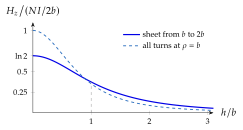
Units: is A/m. Because , the inner turns are worth most at the centre, and the outer turns add less field but extend it further along the axis (Figure 4.1.33): a wireless-charging pad wants a flat field over the receiver, so its turns are spread outward (Application 4.1.4). At to kHz the same coil is run with a few amperes and the field is a few hundred microteslas, enough to transfer several watts across a few millimetres.