Section 4.1 · Topic 2 of 11
4.1.2 Current and current density
Before we can say what field a current produces we need a precise description of the current itself. A current is charge in motion. Consider a region in which charge of volume density moves with velocity , and take a small flat surface element with unit normal at a point P (Figure 4.1.3). In the time every charge that was within the slanted prism of base and edge passes through the element. The height of that prism is , its volume , and the charge it contains is times that volume. The current through is the charge per unit time:
The combination is all that the current through any surface depends on, and it deserves a name of its own.
The current density of charge of density moving with velocity is
The current through a surface is the flux of through it,
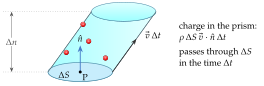
Equation (4.1.8) should look familiar: it is the flux integral of Section 3.2 with replaced by . The current through a surface counts how much passes through it, with the same rule: a surface edge-on to the flow carries no current.
is "amperes per square metre of cross-section", pointing in the direction in which positive charge moves. A current is a flux of , exactly as electric flux is a flux of .
Three forms of the current density are met in practice, and the problems of this section use all of them:
- a volume current , as in a thick wire or busbar (Problems 4.1.5 and 4.1.6),
- a surface current flowing in a thin sheet: current per unit width across the flow, as on a rotating charged disk (Problem 4.1.3), on the winding of a solenoid (Home exercise 4.1.7) or in a flat coil (Problem 4.1.8), and
- a line current in a thin wire (Problems 4.1.1, 4.1.2 and 4.1.4).
They are related exactly as the three charge densities of Section 3.1: a volume element becomes for a sheet and for a wire, where points along the current. With the Dirac delta of Section 3.2 a thin wire on the -axis is written , which integrates over any cross-section to .
Whenever charge moves, there is a current, even if nothing "flows" in the everyday sense. A charged disk spinning about its axis carries the convection current , with (Problem 4.1.3), and a charged ring turning at is a current loop with (Exercise 4.1.17). Rowland showed in 1876 that such convection currents produce exactly the same magnetic field as conduction currents in a wire.
A copper wire of cross-section mm carries A. What is ? Copper has electrons per m: how fast do they drift?
A/m. With , m/s, less than a third of a millimetre per second (Worked example 4.1.2).