Section 4.1 · Problems · 5 of 8
Problem 4.1.5: Solid wire of radius b
Solid wire of radius b
#By using Ampère's formula, find the magnetic field inside and outside a wire with a radius of having a current of .
Source: D. K. Cheng, Field and Wave Electromagnetics, 2nd ed., Example 6-1.
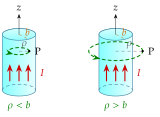
Exactly as in Problem 4.1.4: , so the same circular path works inside and outside the wire, and only changes. Inside, the circle encloses only the part of the current that flows through it.
The thick wire has the same symmetries as the thin one (translation along , rotation about , the mirror), so again , and on a coaxial circle of radius Ampère's formula reads .
Uniform over the cross-section :
The circle encloses only the part of the current that crosses the disk of radius (Figure 4.1.22a):
The circle encloses all of it, .
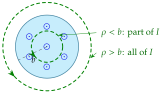
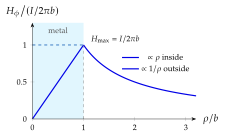
Move the circle inside the wire and see grow as , then check that is continuous at .
on the axis (no current enclosed, and is not even defined there). The two branches agree at , giving the maximum : no jump, as it must be without a surface current. Outside, the wire behaves exactly like the thin wire of Problem 4.1.4, its radius has disappeared (Figure 4.1.22b). Units: A/m. The field inside the copper stores energy: per unit length is , an internal inductance of nH/m, independent of . At high frequency the current crowds into a thin skin and this interior field collapses.