Section 4.1 · Further exercises · 11 of 20
Exercise 4.1.11: Two parallel wires
About the further exercises of Section 4.1
Twenty further exercises in the spirit of the problems, the worked examples and the home exercises, graded from easy to harder within each group. Exercises 4.1.1–4.1.10 belong to the theory of Lecture 8 (the Lorentz force, Biot–Savart's law, flux, force and the vector potential) and Exercises 4.1.11–4.1.20 to the exercise session of Lecture 9 (Ampère's law, coils and rotating charges, measuring and shaping fields). They use only
the two results of the section, for a long straight wire and on the axis of a loop, and superposition.
Two parallel wires
#cf. Problem 4.1.4
Two long parallel wires, cm apart, carry A in opposite directions (go and return of one circuit). Find (a) midway between the wires, (b) in their plane, cm outside the pair, and (c) show that far away () the field decays as , not .
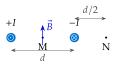
Superposition of two fields of Problem 4.1.4, each circling its own wire by the right-hand rule. This is Exercise 4.1.6 with the numbers of a household circuit, and Ampère's law explains the far field at once.
Each wire produces (Problem 4.1.4), circling the wire by the right-hand rule, and the fields add vectorially.
At M, cm from each wire, the two fields are parallel (the currents are opposite, so the two circulations run the same way between the wires):
At N, cm from the near wire and cm from the far one, the two fields are antiparallel:
In the plane of the wires at the distance from the centre,
Units: is T. A go-and-return pair encloses zero net current, so Ampère's law on a large circle gives : the terms cancel and only the "dipole" term survives (the field-line picture is Figure 4.1.31). Twisting the pair makes even that average out, which is the reason signal cables are twisted.