Section 4.1 · Problems · 8 of 8
Problem 4.1.8: Ring with a non-uniform surface current
Ring with a non-uniform surface current
#There exists a nonuniform surface current density on the ring shown in the figure with an inner radius of and an outer radius of given as
in vacuum where is a known constant. Find the vector potential and the magnetic field at the origin.
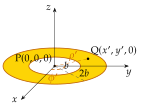
The source is a flat ring, so both and at the origin are surface integrals with the simplest possible geometry, . The point of the problem is that the direction of averages to zero round the ring, so vanishes, while the direction of does not, so survives. Keep the two calculations apart.
The source is the flat ring , , a sheet, so is a surface density and carries A/m. The surface element is , and for the field point at the origin
From Eq. (4.1.15) for a sheet,
The radial and the angular integrals separate, and with (Section 2.3),
inherits the direction of : the element at and the element at have opposite and the same , so they cancel pair by pair, whatever the radial profile of (Figure 4.1.25a).
at one point says nothing about there, because the curl needs in a neighbourhood of the point. So compute directly from Biot–Savart's law for a surface distribution, Eq. (4.1.12):
Now the direction does not cancel. With and one power of is left over, and it cancels the in :
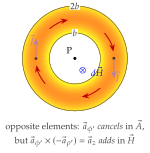
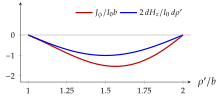
Units: [A/m] times [m] gives A/m, correct for . Sign: on the argument runs from to , so and the current really circulates in the sense, and the right-hand rule then puts along . A second route, ring by ring: a ring of radius carries and gives at its centre (Problem 4.1.2 with ), so
the cancels, every ring counts the same, and gives the same answer (Figure 4.1.25b). Had the ring extended from to , would have been positive and would point along . A flat spiral coil wound from to is, at distances large compared with the turn pitch, exactly this annular sheet, the geometry of wireless-charging pads and induction hobs (Application 4.1.4).