Section 4.1 · Further exercises · 16 of 20
Exercise 4.1.16: Toroidal coil
About the further exercises of Section 4.1
Twenty further exercises in the spirit of the problems, the worked examples and the home exercises, graded from easy to harder within each group. Exercises 4.1.1–4.1.10 belong to the theory of Lecture 8 (the Lorentz force, Biot–Savart's law, flux, force and the vector potential) and Exercises 4.1.11–4.1.20 to the exercise session of Lecture 9 (Ampère's law, coils and rotating charges, measuring and shaping fields). They use only
the two results of the section, for a long straight wire and on the axis of a loop, and superposition.
Toroidal coil
#cf. Home exercise 4.1.7
A toroid of rectangular cross-section has inner radius cm, outer radius cm and closely wound turns carrying A. Use Ampère's law to find inside the winding and outside it, and the values of at , at the mean radius cm and at .
Adapted from: B. M. Notaroš, Electromagnetics, Example 4.12.
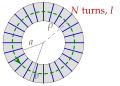
A solenoid bent into a ring. Rotational symmetry makes circle the axis of the toroid, and a coaxial circle threads all turns inside the winding and none (net) outside.
The toroid is invariant under rotation about its axis, so depends on and only. The winding is a sheet of current that flows along the meridians, and by the same argument as for the solenoid : the field lines are circles threading the winding.
Take to be the circle of radius coaxial with the toroid. For (inside the winding) it is pierced by all turns, each carrying in the same sense. For it encloses no current, and for every turn pierces it twice in opposite directions, net zero:
A:
i.e. mT, mT and mT: the field is larger at the inner edge than at the outer one.
Units: A/m. A toroid is a solenoid bent into a ring: is with the local turn density . Its great advantage is that it has no outside field at all, whatever , which is why toroidal cores are used in transformers and chokes that must not disturb (or be disturbed by) their neighbours. A thin toroid () has an almost uniform field .