Section 4.1 · Further exercises · 18 of 20
Exercise 4.1.18: Spinning charged spherical shell
About the further exercises of Section 4.1
Twenty further exercises in the spirit of the problems, the worked examples and the home exercises, graded from easy to harder within each group. Exercises 4.1.1–4.1.10 belong to the theory of Lecture 8 (the Lorentz force, Biot–Savart's law, flux, force and the vector potential) and Exercises 4.1.11–4.1.20 to the exercise session of Lecture 9 (Ampère's law, coils and rotating charges, measuring and shaping fields). They use only
the two results of the section, for a long straight wire and on the axis of a loop, and superposition.
Spinning charged spherical shell
#cf. Problem 4.1.3
A spherical shell of radius carries the uniform surface charge and spins about the -axis with angular velocity . Find (a) the surface current density, (b) at the centre, (c) the magnetic moment. Numbers: cm, μC/m (the most a sphere in air can hold), rpm.
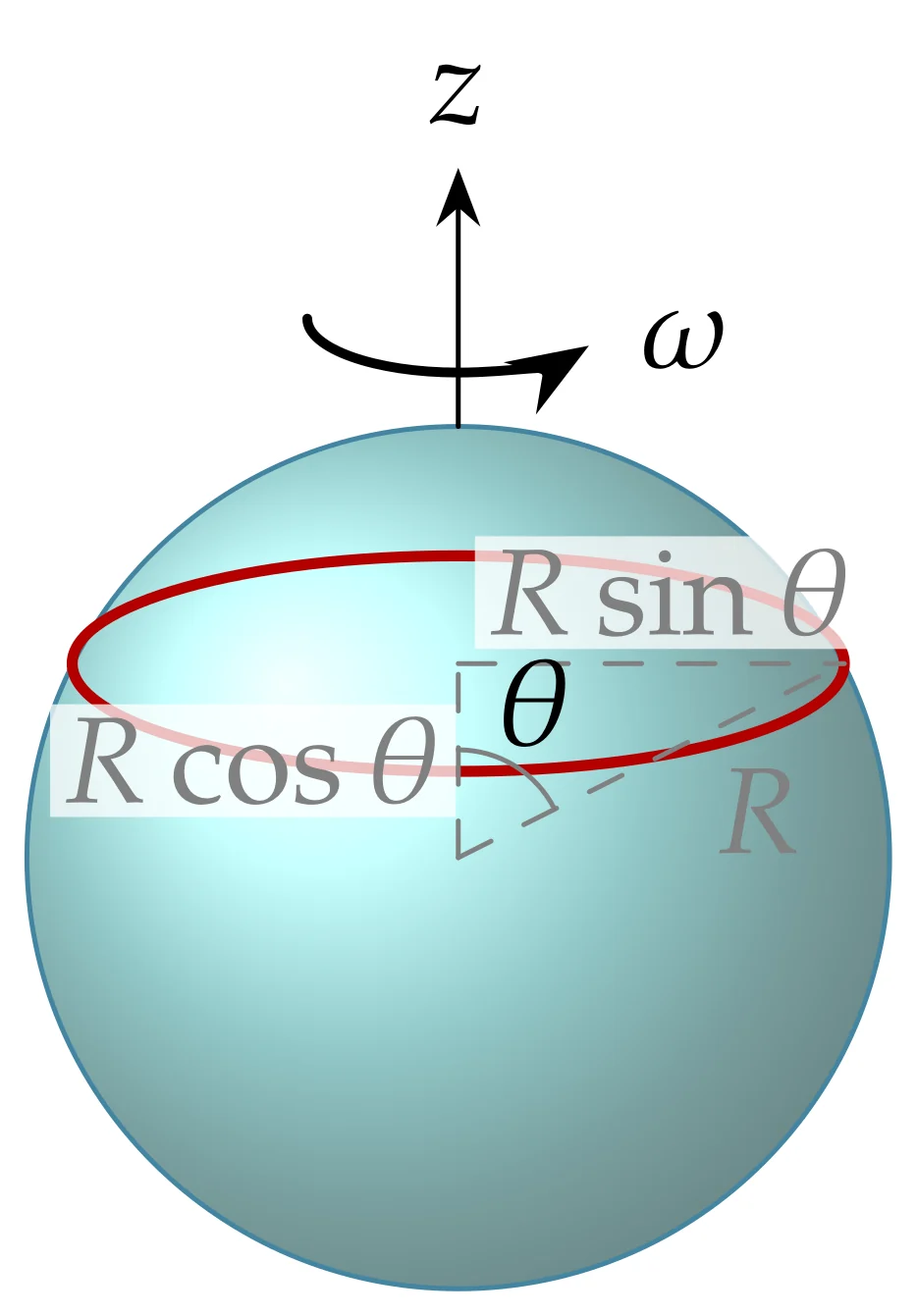
Cut the shell into rings of latitude. Each is a loop of radius at the height above the centre, so every ring is at the same distance from it, and the on-axis loop field of Problem 4.1.2 integrates over .
A point of the shell at the polar angle moves on a circle of radius with speed :
The ring between and has radius , width , current , and lies at the height above the centre. The on-axis loop formula with gives
and :
Each ring has the moment , so , and with , .
rad/s: nT and A m.
Units: is (H/m)(C/m)(1/s)(m) T. Inside a spinning shell the field turns out to be uniform and equal to the centre value, , while outside it is exactly a dipole field of moment , the classical model of a spinning charged particle. The nanotesla numbers show again how weak convection currents are: μC/m at rpm is only mA/m at the equator.