Section 4.1 · Topic 5 of 11
4.1.5 The fundamental equations of magnetostatics
In electrostatics we found two equations that the field must satisfy at every point, and . The vector potential gives us the two corresponding equations of magnetostatics almost for free.
The second fundamental equation: no magnetic charges
Since we have , and the divergence of a curl is identically zero (Section 2.2), it is straightforward that
for every closed surface , the integral form following from the differential one by the divergence theorem (Section 2.4).
Magnetic field lines have no beginning and no end: as much flux enters any closed surface as leaves it. There is no magnetic counterpart of the electric charge, no "north pole" on its own. The lines of either close on themselves (round a wire, through and round a coil) or run off to infinity.
Figure 4.1.10 shows what this means for the field of a current loop: every line that goes up through the loop comes back down outside it and closes. Draw any closed surface in that picture and count crossings: lines going in and lines coming out always balance. Compare the field of an electric dipole (Home exercise 3.1.4), whose lines start on and end on . Far away the two pictures look alike, which is why a small current loop is called a magnetic dipole, but close up they are different: the dipole's lines run from charge to charge through the gap, the loop's lines run through the loop and close round the wire.
The first fundamental equation: Ampère's law
The vector potential also obeys a Poisson equation. Each Cartesian component of Eq. (4.1.15), , has exactly the form of the Coulomb potential of Section 3.3, which satisfies Poisson's equation . Hence, component by component, it is easy to obtain the relation
Finally, after some mathematical calculations (sketched in the box below), we find under the condition , which is the condition that the current is steady: no charge piles up anywhere. From this, using the identity of Section 2.2,
and dividing by we get the first fundamental equation. Its integral form follows from Stokes' theorem (Section 2.4): for any open surface bounded by the closed curve , , and the right-hand side is by Eq. (4.1.8) the current through .
The integral form is also called Ampère's formula or Ampère's circuital law: the circulation of round any closed path equals the current that passes through any surface spanning , counted positive when it passes in the sense given by the right hand with the fingers curled along .
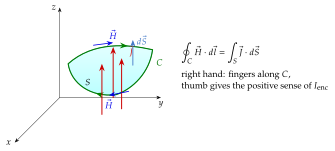
Currents make circulate: go once round a wire and the line integral of adds up to exactly the current you have encircled, whatever the shape of your path and wherever the wire sits inside it. Where there is no current, has no curl, but it may still be there, exactly as exists where .
Poisson's equation for . Writing Eq. (4.1.15) in Cartesian components, each is a Coulomb-type potential of the "charge density" . The Laplacian of with respect to P vanishes for and integrates to over a small ball round (the Dirac delta of Section 3.2), so , which is Eq. (4.1.17).
The divergence of . Since ,
by the product rule and the divergence theorem. The surface term vanishes when is taken outside the current (no current crosses it), and the volume term vanishes for a steady current, . Hence , the Coulomb gauge, and . For a non-steady current is not zero (charge accumulates, ), and Ampère's law needs the correction that Maxwell added, the displacement current of the last chapter of this book.
The two equations side by side
Thus, we have found the two fundamental equations of magnetostatics. They are collected in Table 4.1.1 next to their electrostatic counterparts.
Table 4.1.1. The fundamental equations of electrostatics (Chapter 3) and of magnetostatics (this section).
| Electrostatics | Magnetostatics | |
|---|---|---|
| first equation (curl) | , | , |
| second equation (divergence) | , | , |
| constitutive relation | ||
| potential | , | , |
| source law | Coulomb: | Biot–Savart: |
| "Gaussian" tool | closed surface, flux of | closed path, circulation of |
Compare and with and : the roles of "curl" and "divergence" are exchanged. The sources of the electric field are charges, which make diverge, while the sources of the magnetic field are currents, which make curl. The equation says that there is no magnetic charge, which is why comes from a vector potential and not from a scalar one. In the calculations the exchange shows up as follows: where electrostatics closed a surface round the charge and used symmetry to pull out of a flux integral, magnetostatics closes a path round the current and pulls out of a line integral (Section 4.1.8).
The circulation depends only on the enclosed current, but at a point of depends on all currents, inside and outside. A current outside changes everywhere on and yet contributes zero to the circulation, exactly as an outside charge changes on a Gaussian surface without changing the flux (Section 3.2). This is the principle of the clamp meter (Application 4.1.3) and the reason it ignores neighbouring cables.
A closed path encircles a cable that carries A to a lamp and A back. What is ? And if the path encircles only the outgoing conductor?
Round the whole cable , so the circulation is zero (and a clamp meter round a two-core cable reads nothing). Round one conductor A and the circulation is A, whatever the shape of the path.
Can be a magnetostatic field? Can ?
: impossible, it would need magnetic charge. For the divergence is zero and : a possible field, maintained by the uniform current density (compare Exercise 4.1.13).