Section 4.1 · Topic 6 of 11
4.1.6 Magnetic flux
is called the magnetic flux density, and like every flux density it is integrated over surfaces. The magnetic flux through a surface is determined by
The rain picture of Section 3.2 applies unchanged: counts how many lines of pass through , each crossing weighted by the cosine of the angle between and the normal. Substituting into the above integral and taking into account Stokes' theorem (Section 2.4), we can easily find
where is the rim of , traversed in the sense linked to the normal of by the right-hand rule.
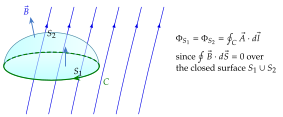
Because field lines never end, every surface stretched over the same rim is crossed by the same lines. The flux "belongs to the rim", and is the formula that says so. One weber is one volt second: a flux of Wb through a loop that falls to zero in s induces V in that loop (Faraday's law, in the chapter on time-varying fields).
Exercise 4.1.7 computes the flux of a long wire through a nearby rectangle both ways, with and with , and Exercise 4.1.19 uses the flux linked by a coil to measure a current. In the next chapter the flux through a circuit will define its inductance.
A circular loop of radius cm lies with its normal at to a uniform field T. What is the flux through it? What is the flux through the hemisphere that has the same rim?
Wb mWb. The hemisphere has the same rim, so the same flux passes through it.