Section 4.1 · Further exercises · 13 of 20
Exercise 4.1.13: Infinite current sheet
About the further exercises of Section 4.1
Twenty further exercises in the spirit of the problems, the worked examples and the home exercises, graded from easy to harder within each group. Exercises 4.1.1–4.1.10 belong to the theory of Lecture 8 (the Lorentz force, Biot–Savart's law, flux, force and the vector potential) and Exercises 4.1.11–4.1.20 to the exercise session of Lecture 9 (Ampère's law, coils and rotating charges, measuring and shaping fields). They use only
the two results of the section, for a long straight wire and on the axis of a loop, and superposition.
Infinite current sheet
#cf. Home exercise 4.1.7
An infinite plane sheet at carries the uniform surface current density [A/m]. (a) Use symmetry and Ampère's law with a rectangular path to find on both sides. (b) A second sheet at carries (a strip line). Find everywhere. Numbers: A/m.
Adapted from: B. M. Notaroš, Electromagnetics, Example 4.15 and Problem 4.14.
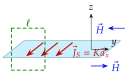
The magnetic counterpart of the charged plane of Problem 3.2.3: symmetry leaves a tangential field perpendicular to the current, odd in , and a rectangle straddling the sheet gives its value. Two sheets superpose like two charged planes.
The sheet is invariant under translations in and , so depends on only. Each strip of the sheet is a line current along whose field circles it in the -plane. By Biot–Savart's law has no -component, and the -components of the strips at and cancel. Hence , and by the mirror symmetry (which reverses the circulation) .
Take the rectangle in the -plane with sides of length parallel to at , traversed so that the enclosed current (along ) is positive, i.e. counter-clockwise when seen from : along at and along at . The -sides contribute nothing ():
with the unit normal pointing from the sheet to the field point. The field is uniform and does not depend on the distance, exactly like of a charged plane. Numbers: A/m, mT on each side.
Superpose: between the sheets () the two contributions, from the lower sheet and from the upper one (its current is and the field point is below it), add. Outside they cancel:
With A/m, mT between the plates, zero outside.
Units: A/m. This is the field inside a solenoid seen from close up: the winding is a cylindrical current sheet , the field inside and outside (Home exercise 4.1.7). The tangential component of jumps by across a current sheet, , which is the magnetic boundary condition of the next section.